Silicon Graphics O2 Computer
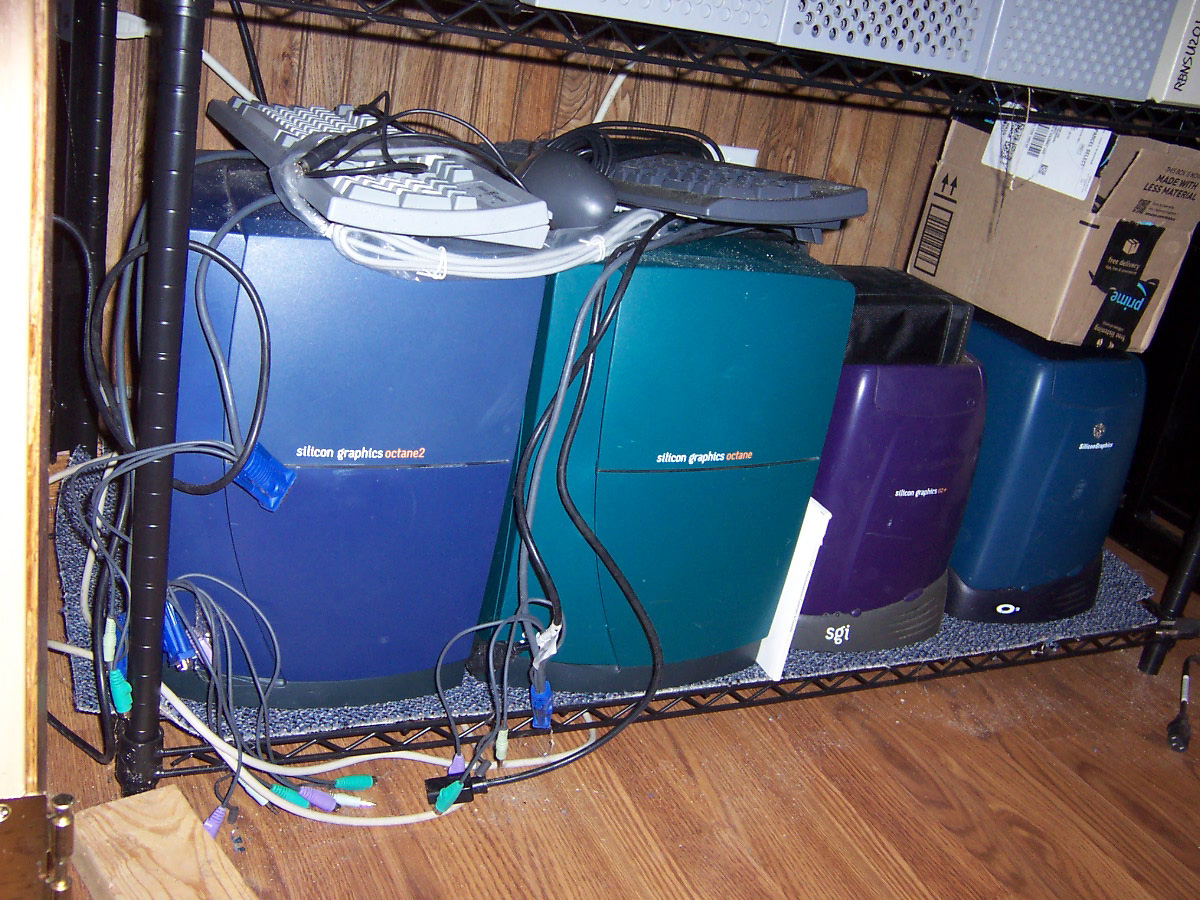
The SGI O2 computer (blue one, far right) was one of the most distinctive workstation computers of the late 1990s, blending advanced multimedia capabilities, elegant industrial design, and powerful visualization hardware into a compact desktop system. Developed by Silicon Graphics — better known as SGI — the O2 represented a dramatic shift in workstation philosophy. Rather than building massive, expensive tower systems reserved for elite research labs and Hollywood studios, SGI attempted to create an affordable and accessible workstation that still retained much of the company’s legendary graphics pedigree.
Released in 1996, the O2 arrived during a fascinating transitional era in computing history. Personal computers based on Intel Pentium processors and Microsoft Windows were rapidly improving, while UNIX workstations from companies such as SGI, Sun Microsystems, and Hewlett-Packard still dominated professional 3D graphics, scientific visualization, and digital video production. SGI had already established itself as a technological powerhouse thanks to its cutting-edge graphics systems, which were used in films such as Jurassic Park, Terminator 2: Judgment Day, and Toy Story. The O2 was designed to bring some of that same capability to a broader audience.
One of the first things people noticed about the SGI O2 was its appearance. The machine featured a smooth, curving case finished in translucent blue-green plastic that looked unlike any other computer of the time. While most PCs were dull beige boxes, the O2 looked futuristic and artistic. Its rounded shell resembled something from a science fiction film rather than a piece of office equipment. The case design also emphasized compactness. Unlike SGI’s larger Indigo or Octane workstations, the O2 could sit comfortably on a desk without dominating the workspace.
Underneath the stylish exterior was an unusual and innovative hardware architecture. Instead of relying entirely on dedicated graphics hardware, SGI engineered the O2 around a system called UMA, or Unified Memory Architecture. In conventional systems of the era, the CPU and graphics subsystem each had separate memory pools, which created bottlenecks when moving large amounts of image or video data. SGI’s unified design allowed the processor, graphics engine, and video subsystems to share the same pool of high-speed memory. This significantly improved efficiency for multimedia tasks and reduced manufacturing costs.
The O2 used processors based on the MIPS architecture, another hallmark of SGI systems. Early models shipped with the MIPS R5000 processor, while later versions used faster R10000 and R12000 chips. These processors were highly respected for scientific and graphical workloads, although they often struggled to compete with rapidly advancing x86 CPUs in raw cost-performance ratios. Nevertheless, the MIPS processors provided excellent floating-point performance, which was important for 3D rendering and simulation work.
A defining feature of the O2 was its exceptional multimedia integration. SGI designed the machine to handle real-time digital video and audio processing in ways that ordinary PCs could not yet match. Many O2 systems included built-in video input and output ports supporting composite, S-Video, and professional digital interfaces. This made the machine extremely attractive to video editors, animators, and broadcasters. At a time when capturing and editing video on a consumer PC often required expensive third-party hardware, the O2 provided sophisticated video capabilities directly from the factory.
The graphics subsystem of the O2 was also notable. Although it lacked the brute-force polygon performance of SGI’s high-end workstations, it excelled at texture mapping, image manipulation, and video streaming. SGI marketed the O2 heavily toward content creators who needed balanced multimedia performance rather than pure geometric rendering power. The machine was especially well-suited for compositing, non-linear video editing, and interactive 3D visualization.
The operating system powering the O2 was IRIX, SGI’s UNIX-based platform renowned for its stability and advanced graphical environment. IRIX offered features that were years ahead of mainstream operating systems, including sophisticated networking, high-performance multiprocessing support, and powerful development tools. Its desktop environment, known as the Indigo Magic Desktop, provided a polished and professional user experience. Many users fondly remember IRIX for its responsiveness and visual elegance.
Software support was another major strength of the O2. The machine ran professional applications widely used in film, engineering, and scientific fields. Programs such as Softimage 3D, Alias PowerAnimator, and Maya thrived on SGI hardware. Researchers also used O2 systems for molecular modeling, medical imaging, and geographic visualization. In educational settings, universities often deployed O2 workstations in computer graphics laboratories because they provided students with access to professional-grade UNIX environments and OpenGL graphics capabilities.
Despite its technological strengths, the O2 entered the market during a period of enormous disruption in the computer industry. Intel processors were advancing at an extraordinary pace, while companies such as NVIDIA and 3dfx Interactive began transforming PC graphics performance. By the late 1990s, consumer PCs equipped with dedicated graphics cards started approaching workstation-level capabilities at a fraction of the cost. This eroded SGI’s competitive advantage.
Another challenge for the O2 was pricing. Although SGI marketed it as an affordable workstation, it was still expensive compared to mainstream PCs. Depending on configuration, an O2 system could cost several thousand dollars. While professionals appreciated the advanced video and UNIX features, many customers found that rapidly improving PCs offered “good enough” performance for less money.
Nevertheless, the O2 earned a loyal following. Users admired its engineering, reliability, and unique personality. The machine developed a reputation as one of the most approachable SGI systems ever made. Hobbyists and collectors today continue to seek out surviving O2 units because of their historical significance and iconic design. The translucent case, integrated multimedia hardware, and distinctive boot chime have become symbols of a remarkable era in workstation computing.
The legacy of the SGI O2 extends beyond nostalgia. Many concepts pioneered in the machine eventually became standard in modern computing. Unified memory architectures are now widely used in contemporary systems, including mobile devices and high-performance GPUs. Integrated multimedia acceleration, once revolutionary in the O2, is now commonplace. The idea of combining elegant industrial design with professional computing power also foreshadowed trends later embraced by companies like Apple.
In retrospect, the SGI O2 stands as both a technological achievement and a symbol of a changing industry. It captured the final years when specialized UNIX workstations represented the cutting edge of digital media creation. Although the rise of commodity PC hardware eventually displaced companies like SGI from mainstream relevance, the O2 remains an enduring reminder of a time when computer manufacturers pursued bold experimentation in architecture, aesthetics, and multimedia innovation. For many enthusiasts, it remains one of the most beautiful and fascinating workstations ever built.