Silicon Graphics O2+ Computer
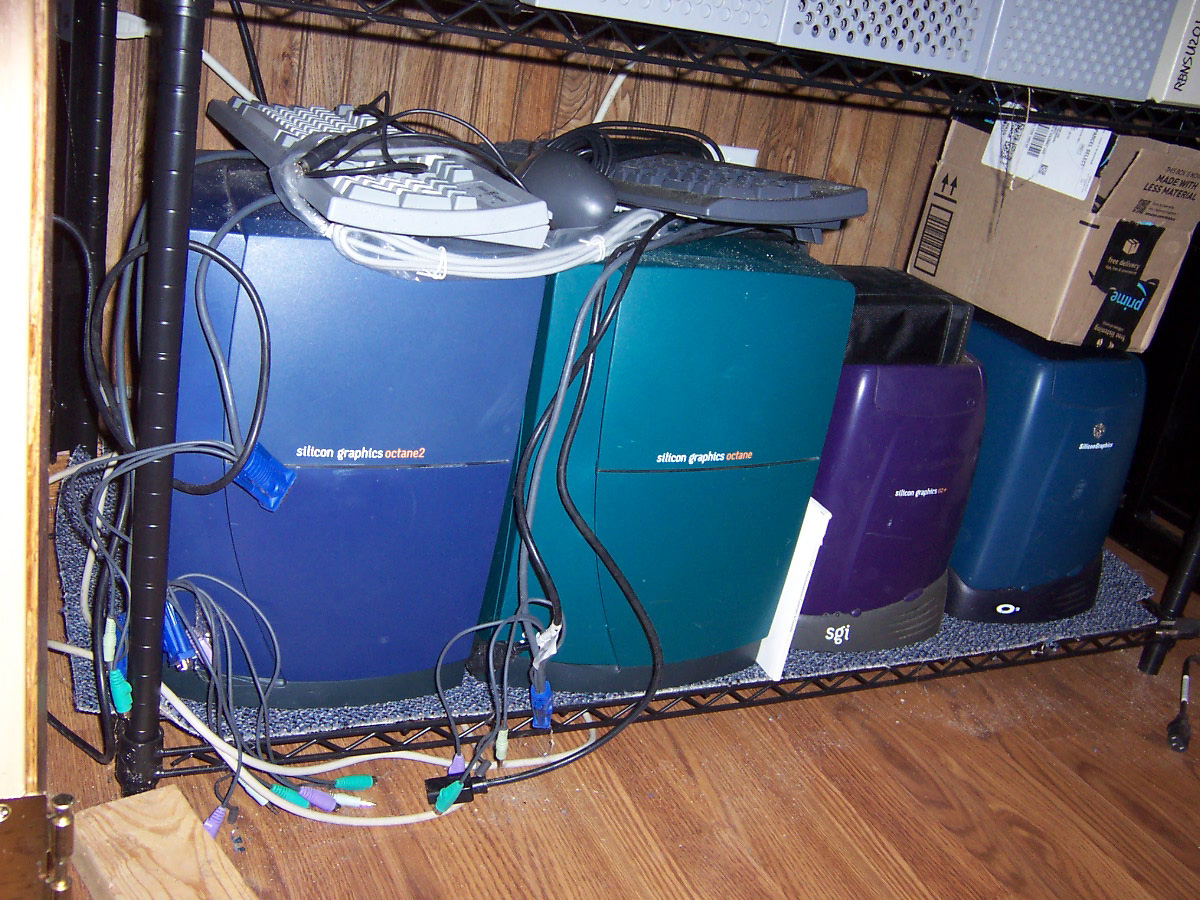
The SGI O2+ computer (purple one, second from right) represented the final and most refined evolution of one of the most distinctive workstation platforms ever created by Silicon Graphics. Building upon the original SGI O2 introduced in 1996, the O2+ enhanced the system with faster processors, improved graphics performance, and upgraded multimedia capabilities while retaining the elegant industrial design and unified memory architecture that made the original machine famous. Though never officially marketed as a completely separate product line, the term “O2+” became widely used among enthusiasts and professionals to describe late-generation O2 systems equipped with advanced hardware upgrades such as the MIPS R12000 processor and updated graphics subsystems.
The SGI O2 platform emerged during a fascinating era in computing history. In the mid-to-late 1990s, UNIX workstations still ruled professional 3D graphics, scientific visualization, and digital video production. Companies like SGI, Sun Microsystems, and Hewlett-Packard produced highly specialized systems designed for engineers, researchers, animators, and filmmakers. SGI stood at the pinnacle of this world, having contributed hardware and software technology used in films such as Jurassic Park, Terminator 2: Judgment Day, and Toy Story. The original O2 was SGI’s attempt to make its legendary graphics technology more affordable and compact. The later O2+ models refined that vision into one of the most capable desktop multimedia workstations of its time.
One of the defining characteristics of the O2+ was its striking physical appearance. Unlike the beige tower PCs that dominated offices in the 1990s, the O2 featured a curving translucent teal enclosure that looked futuristic and artistic. The compact case was designed to sit horizontally on a desk, with an integrated carrying handle that emphasized portability. The design reflected SGI’s belief that workstations could be both technically advanced and visually beautiful. Even decades later, many collectors consider the O2 family among the most attractive computer systems ever produced.
Internally, the O2+ retained the innovative Unified Memory Architecture, or UMA, that distinguished the original O2 from competing workstations. In most computer systems of the era, graphics hardware and the CPU maintained separate memory pools, forcing large amounts of image and video data to be copied back and forth. SGI’s UMA design allowed the CPU, graphics subsystem, and video hardware to share the same high-speed memory. This reduced latency and dramatically improved efficiency for multimedia workloads such as texture mapping, video editing, and image compositing.
The enhanced O2+ systems pushed this architecture further through faster processors and increased memory capacity. Early O2 systems commonly shipped with MIPS R5000 processors running between 180 and 300 MHz. The later O2+ variants frequently included the more powerful MIPS R10000, R12000, or even R14000 processors operating at speeds up to 400 MHz. These processors delivered significantly improved floating-point performance, making the systems more capable for scientific visualization, rendering, and engineering applications.
The MIPS architecture itself was an important part of SGI’s identity. Unlike the Intel x86 processors found in consumer PCs, MIPS chips were designed with a streamlined RISC — Reduced Instruction Set Computing — philosophy that emphasized efficiency and high-performance mathematical operations. SGI workstations gained a reputation for smooth performance in applications requiring large-scale calculations and graphical rendering. In the O2+, the faster MIPS processors transformed the machine from a mid-range workstation into a genuinely powerful professional system.
Graphics performance also improved substantially in the O2+ generation. Although the O2 never matched the raw polygon throughput of larger SGI systems like the Octane or Onyx, it excelled in multimedia integration and texture-intensive tasks. The upgraded CRM graphics subsystem found in higher-end O2+ configurations enhanced texture mapping, OpenGL acceleration, and real-time image processing performance. This made the machine especially attractive for video editors, animators, and digital artists who valued balanced multimedia capability over sheer geometric rendering power.
Perhaps the greatest strength of the O2+ was its advanced digital video functionality. SGI designed the machine as a true multimedia workstation rather than simply a high-performance graphics computer. Many O2+ systems included integrated video input and output hardware supporting composite video, S-Video, and professional digital interfaces. In the late 1990s, this level of video integration was extraordinary. Most consumer PCs still required expensive add-on capture cards to perform basic video editing tasks. The O2+ could capture, process, and output video directly from the motherboard with remarkably low latency.
These capabilities made the O2+ popular in television production, educational media labs, and post-production studios. The machine was widely used for non-linear video editing, animation compositing, broadcast graphics, and multimedia presentations. Its ability to handle real-time video streams while simultaneously rendering 3D graphics gave it an important niche in professional media environments.
The operating system powering the O2+ was IRIX, one of the most respected UNIX environments ever developed. IRIX provided advanced multiprocessing support, sophisticated networking tools, and a polished graphical desktop known as Indigo Magic. Many users praised IRIX for its stability, responsiveness, and elegant interface. The operating system also offered excellent support for OpenGL, the graphics API originally developed by SGI that became the industry standard for professional 3D graphics.
Software availability was another major advantage of the O2+ platform. The machine ran many of the most important graphics and animation programs of the era, including Maya, Softimage 3D, and Alias PowerAnimator. Researchers used O2+ systems for scientific modeling, medical imaging, and geographic visualization. Universities also embraced SGI systems for teaching computer graphics and UNIX system administration.
Despite its impressive technology, the O2+ existed during the decline of the traditional UNIX workstation market. By the early 2000s, rapidly improving Intel processors and increasingly powerful graphics cards from companies such as NVIDIA began delivering workstation-class performance on inexpensive PCs. Windows and Linux systems became more capable each year, reducing the need for proprietary UNIX workstations. SGI struggled to compete against commodity hardware that offered comparable performance at dramatically lower prices.
Even so, the O2+ earned enduring admiration from users and collectors. Many enthusiasts view it as the pinnacle of SGI’s desktop workstation philosophy: compact, elegant, innovative, and deeply optimized for multimedia computing. Its translucent case design, integrated video hardware, and advanced architecture gave it a personality unlike any ordinary PC.
Today, surviving O2+ systems are treasured by retro computing enthusiasts and digital historians. They represent a unique moment in computer history when engineering ambition and industrial design combined to create machines that felt almost artistic in nature. The O2+ was more than simply a workstation; it was a statement about what computing could become when performance, creativity, and elegance were treated as equally important goals.
The legacy of the SGI O2+ continues to influence modern computing. Concepts such as unified memory architectures, multimedia acceleration, and integrated graphics pipelines are now standard features in contemporary computers, tablets, and gaming systems. In many ways, the O2+ anticipated the future decades before the rest of the industry fully caught up.