Silicon Graphics Octane Computer
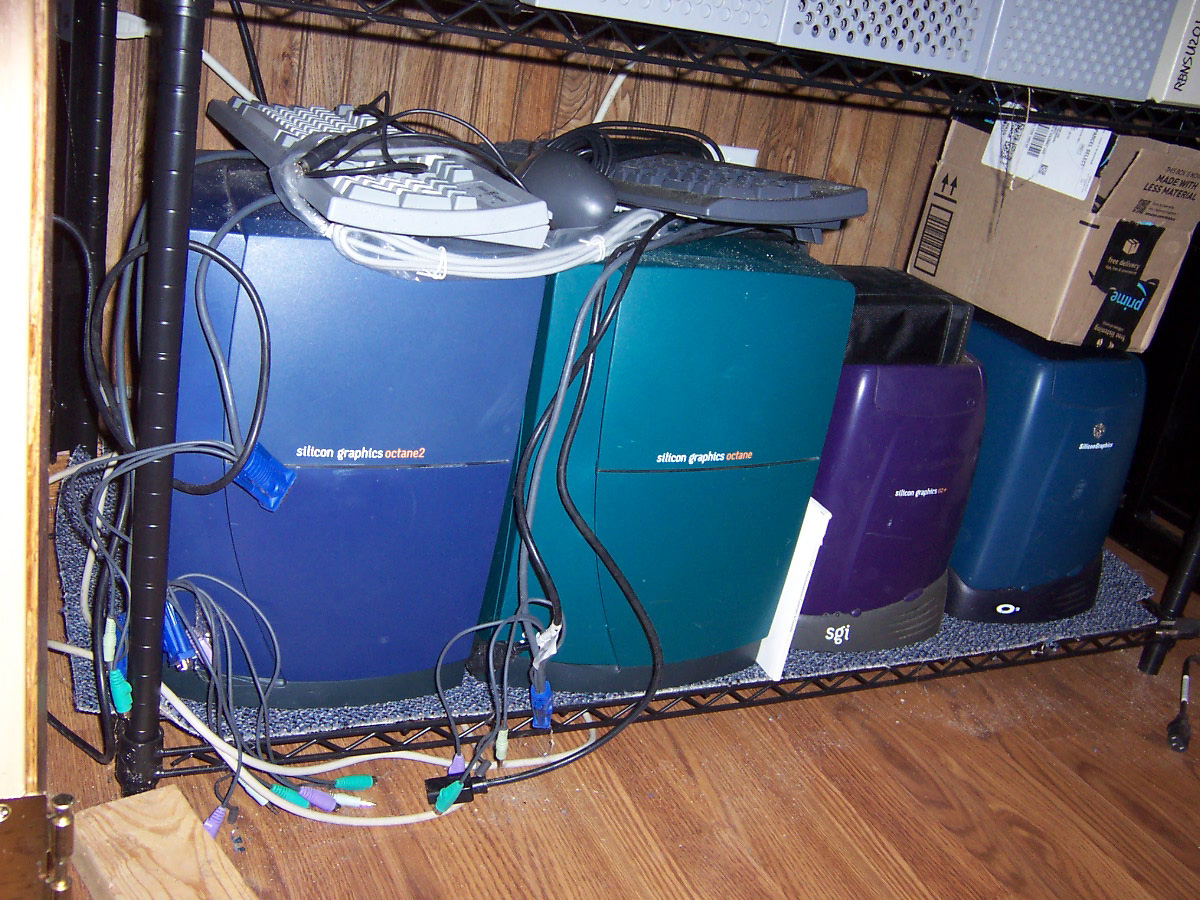
The SGI Octane (teal one, second from left) was one of the most advanced and influential UNIX workstations of the late 1990s, representing the peak of high-performance desktop computing from Silicon Graphics, better known as SGI. Introduced in 1997, the Octane was designed for professionals who required extraordinary graphics power, advanced visualization capabilities, and exceptional computational performance. Engineers, animators, scientists, filmmakers, and researchers all embraced the system for its ability to handle demanding workloads that overwhelmed ordinary personal computers of the era.
The Octane emerged during a period when SGI dominated the world of professional graphics workstations. Throughout the 1980s and 1990s, SGI systems powered some of the most groundbreaking computer-generated imagery ever created. Films such as Jurassic Park, Terminator 2: Judgment Day, Titanic, and The Abyss relied heavily on SGI hardware for rendering and visual effects production. SGI workstations also played important roles in scientific visualization, aerospace engineering, medical imaging, and military simulation. The Octane was developed to continue that tradition while introducing a radically new architecture that pushed workstation performance to new heights.
One of the most striking aspects of the SGI Octane was its industrial design. Unlike ordinary beige PCs of the time, the Octane looked futuristic and almost indestructible. The machine featured a dark gray tower chassis with a bright teal front panel and angular styling that gave it a distinctive, aggressive appearance. The case was large, solid, and heavily engineered, designed not only for aesthetics but also for thermal efficiency and durability. The Octane felt more like industrial or aerospace equipment than a conventional office computer.
Inside the system was an architecture unlike almost anything else on the market. The Octane introduced SGI’s revolutionary XIO technology, a high-bandwidth interconnect architecture built around a crossbar switching fabric. Traditional computers of the era used shared buses for communication between processors, memory, graphics hardware, and peripherals. These buses often became bottlenecks when handling large amounts of graphical or scientific data.
SGI solved this problem with the Octane’s crossbar architecture, which allowed multiple subsystems to communicate simultaneously at very high speeds. Instead of competing for bandwidth on a single shared bus, components could exchange data directly and efficiently. This design dramatically improved overall system performance, especially in graphics-intensive applications and large-scale computational workloads.
The Octane was powered by MIPS processors, continuing SGI’s long-standing reliance on RISC — Reduced Instruction Set Computing — architecture. Early systems typically used the MIPS R10000 processor, while later upgrades introduced faster R12000 and R14000 CPUs. These processors were highly respected for their floating-point performance, which was crucial for 3D graphics rendering, scientific simulations, and engineering calculations.
One of the major strengths of the Octane was its support for multiprocessing. Many configurations included dual processors, allowing the machine to handle parallel workloads far more effectively than single-CPU consumer PCs. Rendering complex 3D scenes, processing simulations, and manipulating large datasets all benefited from the Octane’s multiprocessing capabilities. At a time when multi-core consumer computing did not yet exist, the Octane offered true professional parallel performance.
The graphics hardware available for the Octane was among the best in the world during its peak years. SGI offered several graphics configurations, including SI, SSI, MXI, and MXE graphics systems. These graphics subsystems delivered exceptional OpenGL performance, allowing professionals to interact smoothly with highly detailed 3D models and animations. SGI had originally developed the OpenGL graphics standard itself, and its workstations were renowned for their superior implementation of the technology.
The Octane’s graphics performance made it a favorite in film and animation studios. Artists working on complex visual effects and 3D animation projects could manipulate scenes containing millions of polygons with remarkable responsiveness. Applications such as Maya, Softimage 3D, and Alias PowerAnimator ran exceptionally well on SGI hardware, making the Octane a standard tool in many professional production environments.
Another area where the Octane excelled was scientific and technical visualization. Researchers and engineers used these systems to analyze complex datasets, perform simulations, and visualize phenomena that required enormous computational resources. Fields such as fluid dynamics, seismic analysis, molecular modeling, and medical imaging all benefited from the Octane’s powerful graphics and processing capabilities.
The machine also supported substantial memory and storage configurations. High-end Octane systems could be equipped with gigabytes of ECC memory, which was an enormous amount for the late 1990s. Fast SCSI storage subsystems provided the throughput necessary for handling large media files and scientific datasets. The system’s expandability allowed organizations to tailor configurations for highly specialized workloads.
The operating system running on the Octane was IRIX, SGI’s advanced UNIX-based platform. IRIX was widely admired for its stability, multitasking capabilities, and excellent graphics support. The operating system included the Indigo Magic desktop environment, which offered a polished graphical interface years ahead of many consumer operating systems. Developers and technical users appreciated IRIX for its powerful command-line tools, networking capabilities, and sophisticated support for multiprocessing and OpenGL applications.
The Octane was also known for its excellent video and multimedia capabilities. SGI systems were frequently used in television production and post-production environments because they could handle real-time video processing with impressive efficiency. Specialized video hardware allowed the Octane to work with broadcast-quality digital video streams at a time when most consumer PCs lacked even basic video editing capabilities.
Despite its technical brilliance, the Octane entered the market during a period of major industry transformation. Intel processors were rapidly improving, and graphics hardware companies such as NVIDIA and ATI Technologies began bringing powerful 3D acceleration to consumer PCs. Windows NT and Linux workstations started offering acceptable professional performance at significantly lower costs than proprietary SGI systems.
The Octane was an expensive machine, often costing tens of thousands of dollars in advanced configurations. Large studios, research institutions, and engineering firms could justify the investment, but many smaller companies increasingly migrated toward cheaper PC-based alternatives. Over time, this shift in the market contributed to the decline of SGI’s dominance in professional graphics computing.
Even so, the SGI Octane earned legendary status among technology enthusiasts and professionals. The machine represented a philosophy of uncompromising engineering in which every subsystem was optimized for maximum performance and reliability. It embodied an era when workstation manufacturers pursued bold architectural innovation rather than relying solely on commodity components.
Today, surviving Octane systems are highly prized by collectors and retro computing enthusiasts. Their futuristic appearance, sophisticated engineering, and historical importance make them enduring symbols of the golden age of UNIX workstations. Many enthusiasts continue restoring and operating these machines, not only as nostalgic artifacts but also as reminders of a time when specialized computing hardware pushed the boundaries of what digital technology could achieve.
The legacy of the SGI Octane lives on in modern computing. Concepts such as high-bandwidth interconnects, multiprocessing, hardware-accelerated graphics, and advanced visualization pipelines became foundational elements of contemporary workstations and servers. In many ways, the Octane anticipated the future of high-performance computing years before mainstream systems caught up.