Silicon Graphics Octane2 Computer
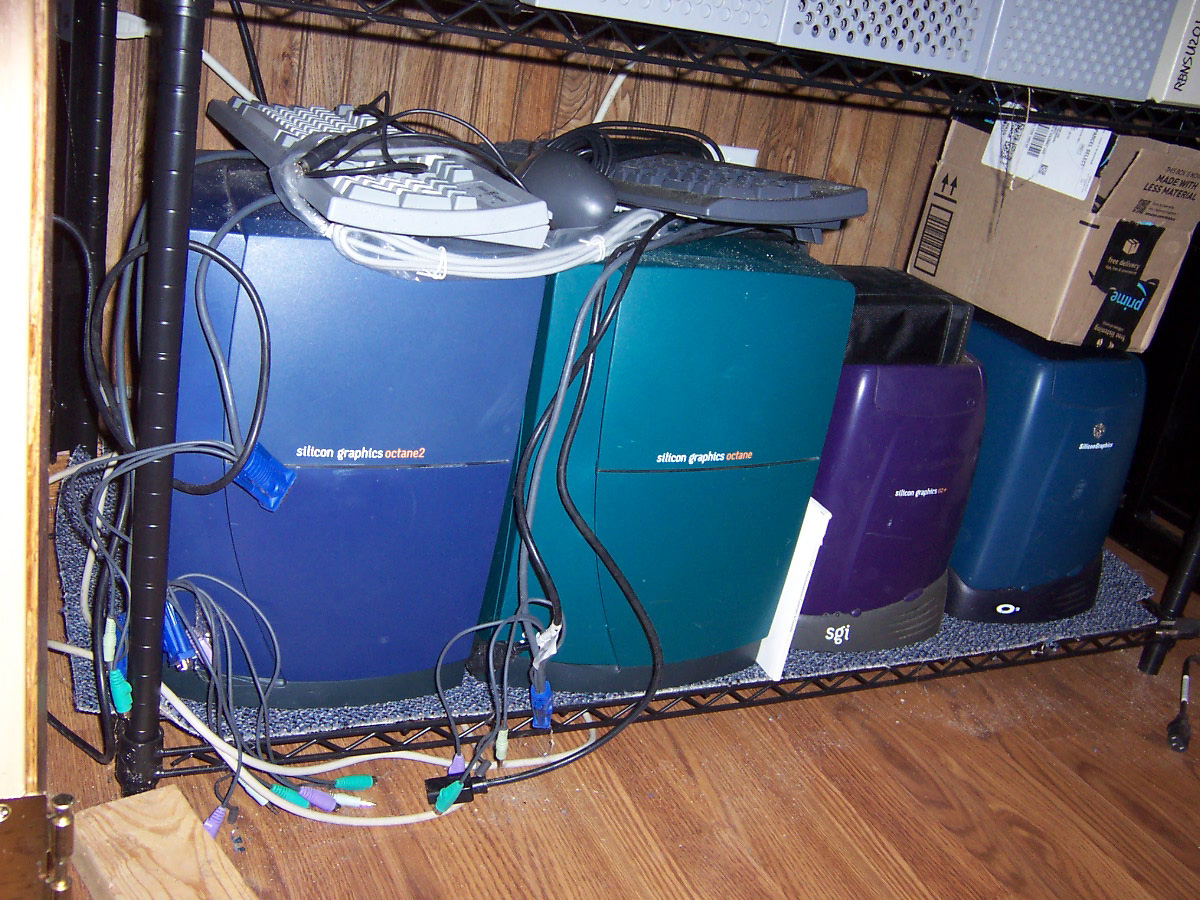
The SGI Octane2 (blue one, far left) stands as one of the most powerful and visually iconic UNIX workstations ever produced by Silicon Graphics. Released in 2000 as the successor to the original SGI Octane, the Octane2 represented the culmination of SGI’s workstation engineering philosophy during the golden age of high-end graphics computing. Combining extraordinary graphics performance, advanced multiprocessing capabilities, and a revolutionary internal architecture, the Octane2 became a legendary system in fields such as film production, scientific visualization, engineering, and industrial design.
To understand the importance of the Octane2, it is necessary to appreciate the computing landscape of the late 1990s and early 2000s. During this period, SGI occupied a unique position at the top of the professional graphics world. The company’s systems powered visual effects studios, research laboratories, military simulations, and advanced CAD environments. Hollywood productions including Jurassic Park, Terminator 2: Judgment Day, Titanic, and The Matrix relied heavily on SGI workstations for 3D rendering and digital effects. While consumer PCs were rapidly improving, SGI systems still dominated tasks requiring enormous graphical and computational power.
The original SGI Octane debuted in 1997 and introduced a radical new system architecture centered around a technology called XIO. Unlike traditional bus-based workstation designs, the Octane used a high-speed crossbar switch that allowed processors, memory, graphics, and I/O subsystems to communicate simultaneously at extremely high bandwidth. This architecture eliminated many of the bottlenecks found in conventional workstations and allowed the machine to scale efficiently for graphics-intensive workloads.
The Octane2 refined and enhanced this already impressive platform. Externally, the machine maintained the distinctive industrial design that made the Octane family instantly recognizable. The Octane2 featured a compact tower chassis with a bright teal front panel and a dark gray body. The case was heavily engineered, with thick plastics and an internal metal frame designed for durability and airflow. The machine looked more like aerospace equipment than an office computer, reflecting SGI’s reputation for producing elite professional hardware.
Inside the Octane2 was some of the most advanced workstation technology available at the time. The system typically used one or two MIPS R12000 or R14000 processors, running at speeds ranging from 300 MHz to 600 MHz depending on configuration. These processors were based on the MIPS RISC architecture, which emphasized high efficiency and powerful floating-point performance. In scientific computing and 3D rendering applications, the Octane2 delivered remarkable computational capability for its era.
One of the defining strengths of the Octane2 was its multiprocessing design. Many configurations supported dual CPUs, allowing the machine to perform parallel processing tasks with impressive efficiency. This was especially valuable for rendering, simulation, and video production workloads, where multiple processors could dramatically reduce computation times. At a time when most consumer PCs still operated with a single processor, the Octane2 represented true high-end parallel computing on the desktop.
Perhaps the most celebrated feature of the Octane2 was its graphics subsystem. SGI offered multiple graphics configurations for the system, including SSI, SSE, MXE, and the legendary VPro graphics family. The VPro graphics architecture, introduced with the Octane2, significantly improved geometry processing, texture mapping, and real-time rendering performance. High-end V12 VPro graphics configurations were capable of astonishing visual performance for the era, delivering smooth manipulation of highly detailed 3D scenes.
These graphics systems excelled in professional OpenGL applications, an area where SGI historically dominated. In fact, Silicon Graphics originally developed OpenGL itself, and its workstations provided some of the best implementations available. The Octane2 became a preferred platform for engineers, animators, and researchers who required highly accurate real-time 3D visualization.
The system’s memory and storage architecture were equally impressive. Octane2 systems supported large amounts of high-speed ECC memory, often reaching several gigabytes in maximum configurations. This allowed the machine to work with massive datasets and complex 3D scenes that would overwhelm ordinary PCs of the time. The system also featured fast SCSI storage options and highly expandable internal drive bays, giving users the ability to configure substantial storage arrays for media production and scientific data.
The operating system running on the Octane2 was IRIX, SGI’s advanced UNIX platform renowned for stability, responsiveness, and professional graphics support. IRIX provided sophisticated multitasking, networking, and multiprocessing capabilities years ahead of mainstream consumer operating systems. The Indigo Magic desktop environment offered a polished graphical interface that many users considered elegant and highly efficient.
Software support for the Octane2 was exceptional in professional industries. The machine ran advanced applications such as Maya, Softimage 3D, and Alias PowerAnimator. These programs were central tools in the film and animation industries during the late 1990s and early 2000s. The Octane2 was also widely used in medical imaging, oil and gas exploration, military simulation, and scientific research.
One area where the Octane2 truly excelled was video and compositing work. SGI systems were famous for their ability to manipulate uncompressed digital video in real time, and the Octane2 continued that tradition. When equipped with advanced video hardware, the system became an extremely capable platform for broadcast production, compositing, and non-linear editing. This made it popular among television networks and post-production facilities.
Despite its extraordinary capabilities, the Octane2 arrived during a difficult transitional period for the workstation industry. Commodity PC hardware was advancing rapidly, driven by increasingly powerful Intel processors and dedicated graphics cards from companies such as NVIDIA and ATI Technologies. Linux and Windows NT systems began offering acceptable performance for many professional workloads at far lower prices than proprietary SGI workstations.
The Octane2 was also extremely expensive. Fully configured systems with dual processors and high-end VPro graphics could cost tens of thousands of dollars. While major studios and engineering firms could justify the expense, smaller organizations increasingly migrated toward cheaper PC-based alternatives. This market shift ultimately contributed to SGI’s decline in the workstation industry.
Nevertheless, the Octane2 developed an enduring reputation as one of the finest workstations ever created. Enthusiasts admired its engineering sophistication, reliability, and raw graphical power. The machine embodied a philosophy of uncompromising design in which every subsystem was optimized for maximum professional performance.
Today, the Octane2 remains highly respected among retro computing collectors and former SGI professionals. Restored systems are often showcased as examples of peak workstation engineering from the UNIX era. The machine’s futuristic appearance, advanced architecture, and legendary graphics capabilities continue to fascinate computer historians and technology enthusiasts alike.
The legacy of the SGI Octane2 extends well beyond nostalgia. Many technologies pioneered in systems like the Octane2 — high-bandwidth interconnects, advanced multiprocessing, hardware-accelerated 3D graphics, and professional visualization pipelines — became foundational concepts in modern computing. In many ways, the Octane2 anticipated the needs of future high-performance graphics systems long before mainstream hardware caught up.
More than simply a workstation, the SGI Octane2 represented the pinnacle of a unique era in computing history, when specialized UNIX machines pushed the boundaries of visual computing and engineering innovation.